In 2026, relying on a standard GPS to reach John F. Kennedy International Airport isn’t a strategy; it’s a gamble. With the $19 billion redevelopment project reaching its peak disruption this year, traditional navigation tools often fail to keep pace with daily roadway reconfigurations and shifting terminal access points. You’ve likely felt the mounting pressure of watching an international flight window narrow while your vehicle sits motionless on the Van Wyck Expressway. It’s a level of unpredictability that high-profile travelers and corporate executives simply cannot afford.
We understand that for your schedule, “on time” is the only acceptable outcome. This executive guide masters the complex logistics of avoiding traffic to JFK by utilizing professional route auditing and the specialized knowledge of veteran chauffeurs. You’ll learn which specific corridors remain viable during peak construction hours, how to bypass the most congested interchanges, and why a dedicated chauffeured service provides a level of reliability that standard ride-hailing apps can’t match. We’re moving beyond simple directions to provide a comprehensive, stress-free transit plan for New York’s most challenging commute.
Key Takeaways
- Identify why mid-week travel presents higher risks for international flight windows and how to time your departure against the Friday afternoon exodus.
- Navigate the 2026 roadway reconfigurations by understanding which specific arteries offer the highest reliability for avoiding traffic to JFK.
- Learn how real-time dispatch monitoring and professional route auditing overcome the limitations of standard consumer GPS applications during peak construction.
- Establish a reliable transit plan using the “3-Layer Buffer” strategy to protect your schedule against unannounced construction detours and terminal changes.
- Transition your commute into a productive mobile office experience by selecting a chauffeured service focused on quiet luxury and absolute punctuality.
The 2026 JFK Traffic Landscape: Why the Old Routes Fail
The logistics of reaching Queens have changed. In 2026, the transit patterns that commuters relied on for decades have dissolved. The primary reason is a convergence of massive infrastructure overhaul and systemic shifts in how traffic flows through the five boroughs. The Van Wyck Expressway remains the most notorious bottleneck in the region, frequently handling over 100,000 vehicles daily at its interchange with the Belt Parkway. However, the modern challenge of avoiding traffic to JFK involves more than just dodging the Van Wyck; it requires understanding a fragile ecosystem where a single stall on the Kosciuszko Bridge can cause a localized gridlock that stretches all the way to the airport gates.
The Congestion Pricing Shift
Manhattan’s updated congestion pricing has created a noticeable migration of vehicles. To avoid the tolls, drivers now saturate the FDR Drive and the Queens-Midtown Tunnel in higher volumes than ever before. This shift has pushed a surge of traffic onto the Brooklyn-Queens Expressway (BQE), turning what was once a viable alternative into a secondary choke point. In 2026, Manhattan’s updated tolling structures have redirected thousands of vehicles toward outer-borough corridors, creating unprecedented saturation on routes once considered reliable bypasses. For the executive traveler, this means the “back ways” are now as crowded as the main highways.
JFK Construction Update 2026
The physical layout of the airport is in a state of flux. The $19 billion redevelopment project has reached a critical phase, particularly with the New Terminal One. While the first phase is set to open in June 2026, the surrounding JFK Airport infrastructure is currently a maze of temporary lane closures and detours. These changes occur so rapidly that standard GPS applications often fail to predict the gridlock within the Central Terminal Area. The final two miles of the journey, typically the most predictable, have become a “Terminal Loop” where vehicles can spend thirty minutes just reaching a curb.
Professional chauffeurs navigate this by monitoring real-time dispatch data rather than consumer-grade maps. They understand that avoiding traffic to JFK in this environment isn’t about finding a secret road. It’s about constant route auditing and the ability to pivot before a delay becomes a missed flight. Reliability in 2026 is built on this specialized, local expertise and an unflappable approach to New York’s dynamic road network.
Strategic Timing: The Best (and Worst) Times to Head to JFK
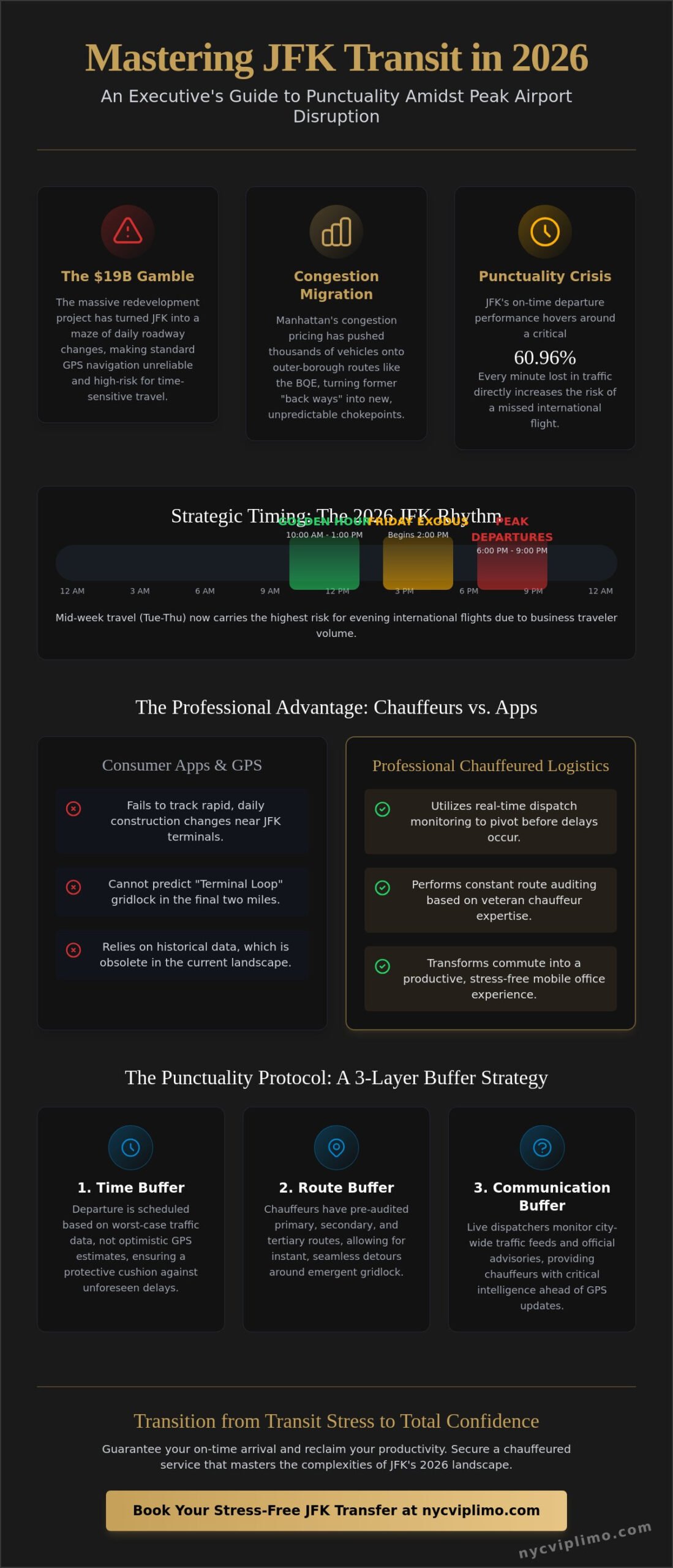
Timing your arrival at Queens’ most active terminal is no longer a matter of simple intuition. In 2026, the traditional rush hour has expanded into a complex series of “Executive Peaks” that catch many travelers off guard. While weekends were once the primary concern, mid-week travel from Tuesday through Thursday now presents the highest risk for corporate departures. This shift is driven by a high volume of business travelers attempting to maximize their time in Manhattan before catching evening international flights. Mastering the art of avoiding traffic to JFK requires moving beyond simple GPS estimates and analyzing the specific departure waves that define the airport’s rhythm.
The Friday afternoon exodus remains a significant hurdle, but the data suggests a counterintuitive trend. Many travelers attempt to beat the rush by leaving at 2:00 PM, creating a premature bottleneck that often exceeds the congestion seen at 5:00 PM. Additionally, the evening surge between 6:00 PM and 9:00 PM coincides with the primary wave of European and Asian departures. With JFK’s on-time departure performance hovering around 60.96% in early 2026, every minute lost on the Van Wyck or Belt Parkway increases the likelihood of a missed connection. Predictable transit relies on identifying these windows before you ever step into the vehicle.
The Window of Opportunity
Success often depends on identifying the “Golden Hour,” typically between 10:00 AM and 1:00 PM, when construction activity and commuter volume reach a temporary equilibrium. However, external variables can instantly dissolve these windows. Major NYC events like the UN General Assembly or Fashion Week create ripple effects that extend far beyond Manhattan. We recommend checking official JFK traffic advisories daily. Weather patterns in the Tri-State area also play a decisive role; even a light rain can reduce ground speeds by 20% across all major airport corridors.
The 3-Layer Buffer Strategy
Reliability is built through a structured approach to time management. We utilize a three-layer buffer to ensure punctuality regardless of roadway conditions:
- Layer 1: The Transit Buffer. We calculate the base drive time and add a 30% margin to account for unannounced construction detours.
- Layer 2: The Security Buffer. This accounts for terminal-specific TSA wait times, which vary significantly between the New Terminal One and Terminal 4.
- Layer 3: The Professional Buffer. Our chauffeurs arrive 15 minutes before your scheduled pickup to handle luggage and ensure a prompt departure.
By integrating these layers, you reclaim control over your schedule. For those who demand absolute precision, securing a premier JFK Airport Limo Service ensures that these logistics are managed by experts, allowing you to focus on your upcoming flight rather than the road ahead.
Comparing JFK Routes: Van Wyck vs. Belt Parkway vs. Local Arteries
Choosing the correct corridor is a tactical decision based on real-time variables. While the Van Wyck Expressway remains the standard approach, its reliability in 2026 is frequently compromised by peak construction activity. For professional chauffeured services, the HOV and Bus lanes often provide the only viable path for avoiding traffic to JFK when the main lanes reach total saturation. Conversely, the Belt Parkway offers a scenic alternative for those departing from South Brooklyn or Lower Manhattan, though its narrow lanes and high accident frequency make it a volatile choice during inclement weather.
The Grand Central Parkway presents a different set of challenges, primarily centered around the Kew Gardens Interchange. This complex junction is a frequent site of sudden congestion as traffic merges from the Jackie Robinson Parkway and the Van Wyck. For Midtown travelers, this route is often the first choice of consumer GPS apps, yet it lacks the recovery options available on local arteries like Queens Boulevard or Woodhaven Boulevard. When the Interchange locks up, the delay can be catastrophic for your flight window.
The Van Wyck vs. The Belt
The following table outlines typical transit expectations for key Manhattan departure points in 2026, assuming mid-week peak travel conditions.
| Departure Point |
Primary Route |
Est. Transit Time (Peak) |
Reliability Grade |
| Wall Street |
Belt Parkway |
55 – 80 Minutes |
Moderate |
| Midtown East |
Van Wyck Expwy |
50 – 95 Minutes |
Low (Construction) |
| Upper West Side |
Grand Central Pkwy |
60 – 90 Minutes |
Low |
Route selection depends heavily on the day’s specific constraints. The Van Wyck is currently plagued by lane shifts near the airport entrance, making it a high-risk choice despite the HOV lane’s benefits. The Belt Parkway is safer for luxury SUVs and sedans since commercial trucks are prohibited, but it suffers from poor drainage during heavy rain. During inclement weather, the Van Wyck is generally the more stable choice due to its wider lanes and better-maintained infrastructure.
The ‘Professional’ Back-Roads
When highways fail, professional logistics rely on secondary arteries. The Jackie Robinson Parkway serves as a tactical surge for specific Queens-bound transfers. Its winding turns make it unsuitable for motor coaches, but it’s an excellent bypass for a signature JFK Airport Limo Service vehicle. Linden Boulevard remains a staple fallback for travelers from Lower Manhattan, providing a steady flow when the Belt Parkway is crippled by accidents. This is why our chauffeurs audit three distinct routes before the engine ever starts. They don’t just follow a blue line on a screen; they execute a pre-vetted transit plan optimized for the current hour’s unique disruptions.
Consumer navigation apps like Waze and Google Maps are reactive by design. They rely on crowd-sourced data that often lags behind the reality of a sudden lane closure or a security-related terminal detour. For the executive traveler, relying on these tools is a passive approach that lacks the operational depth required for 2026’s volatile road conditions. Achieving true precision in avoiding traffic to JFK requires active logistics, where a dedicated dispatch team and an experienced chauffeur work in tandem to outpace the digital algorithms.
The difference lies in the Dispatch-Driver connection. While a standard app might suggest a route based on current speed, our dispatch center monitors proprietary data feeds and Port Authority alerts that predict congestion before it manifests. This constant route auditing allows for preemptive pivots. If a stall occurs on the Queens-Midtown Tunnel approach, the chauffeur is redirected long before they reach the bottleneck. This managed approach transforms the journey from a stressful commute into a seamless transition.
Active Route Auditing
Professional navigation is a proactive discipline. Dispatch centers act as a secondary set of eyes, filtering real-time information from multiple sources to identify the most efficient corridor for that specific hour. This is the core of active chauffeur navigation. A professional chauffeur who knows the terminal layouts by heart can navigate the intricate inner loops of the Central Terminal Area without relying on the delayed signals of a digital map. This local expertise is invaluable when navigating the shifting construction fences of the New Terminal One project.
The Meet & Greet Advantage
The logistical management extends beyond the highway. Standard ride-hailing services often subject passengers to the “Rideshare Curb” chaos, which frequently involves taking a shuttle or waiting in a secondary lot. Our JFK Airport Limo Service utilizes coordinated arrivals to bypass this friction. By monitoring your flight’s progress and gate-specific drop-off logistics, we ensure the vehicle is positioned at the most efficient access point the moment you are ready. This eliminates terminal dwell time and ensures that your transition from the vehicle to the gate is as swift as the drive itself.
Beyond time savings, professional logistics prioritize the “mobile office” environment. Smooth, steady driving is more efficient and provides a stable atmosphere for taking calls or preparing for a meeting. This level of curated transit is only possible through a dedicated chauffeured service. To experience a commute managed by experts, book your JFK Airport Limo Service today and reclaim your time.
NYC VIP Limo: Your Partner in Stress-Free JFK Transfers
Reliability in New York’s most demanding travel environment requires more than just a vehicle. It demands a sophisticated logistics partner capable of navigating the peak year of airport redevelopment. NYC VIP Limo provides that stability through a premier JFK Airport Limo Service that prioritizes your schedule above all else. Our global standards of excellence ensure that every transfer is handled with the same level of precision, whether you’re traveling to a local terminal or utilizing our Signature FBO Chauffeur Services for private aviation. By focusing on active route auditing, we’ve mastered the art of avoiding traffic to JFK during even the most disruptive construction phases.
Our Punctuality Guarantee is the foundation of our service. In an era where 2026 roadway reconfigurations can add thirty minutes to a trip without warning, our dispatch team uses predictive data to stay ahead of the curve. We don’t just react to delays; we anticipate them. This proactive stance is what separates a professional chauffeured service from standard transportation. We provide the security and discretion required by corporate executives and high-profile travelers, ensuring that your arrival is as prestigious as your destination.
The Mobile Office Experience
We’ve optimized our 2026 fleet to serve as a seamless extension of your professional life. Our luxury sedans and SUVs feature high-speed Wi-Fi and privacy partitions, allowing you to maintain productivity while in transit. The back of a quiet luxury vehicle is the ideal environment to finalize a presentation or conduct a confidential briefing. Instead of losing hours to the gridlock of the Van Wyck, you can turn your commute into billable time or a period of necessary rest before a long-haul flight. Every vehicle in our fleet is maintained to a global standard of excellence, providing a sanctuary of calm amidst the chaos of New York transit.
Seamless Booking and Reliability
Our commitment to absolute reliability is backed by 24/7 customer support and a dedicated dispatch team. We monitor your flight status in real-time, adjusting pickup times automatically to accommodate delays or early arrivals. Unlike on-demand ride-hailing apps, we provide flat-rate pricing that remains consistent regardless of current traffic surges. This transparency allows you to budget your executive travel with confidence, knowing that the logistics are managed by experts who understand New York’s unique rhythms. Our team is adaptable and unflappable, possessing the resources to maintain a consistent standard of luxury regardless of the complexity of your request. Secure your on-time JFK arrival with NYC VIP Limo and experience the difference that professional chauffeured services provide.
Secure Your Arrival in a Changing Landscape
In 2026, navigating the $19 billion redevelopment of New York’s primary gateway requires a shift from reactive driving to professional logistics. Success in avoiding traffic to JFK is no longer about luck; it’s about utilizing active route auditing and the specialized knowledge of a dedicated dispatch team. By moving beyond the limitations of standard GPS and embracing a structured “3-Layer Buffer” strategy, you protect your schedule against the volatility of the Van Wyck and the shifting patterns of the Central Terminal Area.
NYC VIP Limo provides the stability needed for high-stakes travel. Our 24/7 Professional Dispatch Monitoring and Punctuality Guarantee ensure that construction detours never compromise your flight window. With a luxury fleet optimized for the mobile office, you can maintain your productivity in a secure, quiet environment. Don’t leave your international departure to the unpredictability of ride-hailing apps. Book Your Reliable JFK Airport Limo Service Now and experience a seamless, prestigious transition to your next destination. Your journey deserves the peace of mind that comes with global excellence.
Frequently Asked Questions
How much time should I allow for traffic to JFK from Manhattan?
You should allow at least 90 to 120 minutes during peak hours to ensure a reliable arrival. While the drive may take 45 minutes during off-peak times, the $19 billion redevelopment project has made transit times highly volatile in 2026. Building in this buffer is the most effective strategy for avoiding traffic to JFK during the most disruptive phases of airport construction.
Is it faster to take the LIRR or a car service to JFK in 2026?
The LIRR offers a fixed schedule, but a car service provides a seamless door-to-door experience that public transit cannot match. While trains avoid road congestion, they require a transfer to the AirTrain, which costs $8.75 as of early 2026. For executive travelers, the ability to work in a private, luxury environment with professional luggage handling outweighs the minor time savings of navigating crowded rail stations.
What is the best route to JFK to avoid the Van Wyck Expressway?
The Belt Parkway is the primary alternative, though professional drivers often utilize the Jackie Robinson Parkway or Linden Boulevard as tactical bypasses. Route selection depends on real-time data from our dispatch center, which audits multiple corridors before your journey begins. We choose the path that offers the highest predictability based on that hour’s specific construction closures and accident reports.
Does NYC congestion pricing affect the cost of a limo to JFK?
Manhattan’s updated congestion pricing has redirected traffic flow and impacted the cost of various transit corridors. Tolls for major crossings like the Queens Midtown Tunnel increased on January 4, 2026, affecting all vehicles entering or exiting the zone. We incorporate these updated tolling structures into our logistics planning, and our flat-rate pricing helps you avoid the uncertainty of the surge rates common with ride-hailing apps.
What happens if my flight is delayed and I have a car booked?
We monitor your flight status in real-time and adjust your chauffeur’s arrival time automatically. There is no need for you to coordinate a new pickup if your schedule shifts; our dispatch team handles the updates based on live aviation data. This ensures your vehicle is waiting at the curb the moment you exit the terminal, regardless of when your flight actually lands.
Can a professional chauffeur service help me find the right terminal at JFK?
Our chauffeurs are specifically trained to navigate the evolving terminal landscape, including the New Terminal One opening in June 2026. With the airport undergoing massive roadway reconfigurations, having a driver who understands the latest gate-specific drop-off logistics is essential. We ensure you’re dropped off at the most efficient entrance for your specific airline to minimize your walking time.
Is there a specific day of the week when JFK traffic is lightest?
Mondays and weekends typically experience lighter executive volume compared to the mid-week surge. The Tuesday through Thursday “Executive Peak” remains the most challenging time for avoiding traffic to JFK due to high business travel demand. Friday afternoons are also notoriously difficult, as the weekend exodus often begins as early as 2:00 PM, creating premature bottlenecks on all major arteries.
How does NYC VIP Limo monitor real-time traffic for my pickup?
Our dispatch center utilizes a combination of official Port Authority alerts, proprietary traffic data, and real-time feedback from our fleet. This “active navigation” approach allows us to identify bottlenecks before they appear on standard consumer GPS apps. We maintain a constant connection between the driver and dispatch to pivot routes the moment a delay is detected on your path.




In 2026, relying on a standard GPS to reach John F. Kennedy International Airport isn’t a strategy; it’s a gamble. With the $19 billion redevelopment project reaching its peak disruption this year, traditional navigation tools often fail to keep pace with daily roadway reconfigurations and shifting terminal access points. You’ve likely felt the mounting pressure of watching an international flight window narrow while your vehicle sits motionless on the Van Wyck Expressway. It’s a level of unpredictability that high-profile travelers and corporate executives simply cannot afford.
We understand that for your schedule, “on time” is the only acceptable outcome. This executive guide masters the complex logistics of avoiding traffic to JFK by utilizing professional route auditing and the specialized knowledge of veteran chauffeurs. You’ll learn which specific corridors remain viable during peak construction hours, how to bypass the most congested interchanges, and why a dedicated chauffeured service provides a level of reliability that standard ride-hailing apps can’t match. We’re moving beyond simple directions to provide a comprehensive, stress-free transit plan for New York’s most challenging commute.
Key Takeaways
Table of Contents
The 2026 JFK Traffic Landscape: Why the Old Routes Fail
The logistics of reaching Queens have changed. In 2026, the transit patterns that commuters relied on for decades have dissolved. The primary reason is a convergence of massive infrastructure overhaul and systemic shifts in how traffic flows through the five boroughs. The Van Wyck Expressway remains the most notorious bottleneck in the region, frequently handling over 100,000 vehicles daily at its interchange with the Belt Parkway. However, the modern challenge of avoiding traffic to JFK involves more than just dodging the Van Wyck; it requires understanding a fragile ecosystem where a single stall on the Kosciuszko Bridge can cause a localized gridlock that stretches all the way to the airport gates.
The Congestion Pricing Shift
Manhattan’s updated congestion pricing has created a noticeable migration of vehicles. To avoid the tolls, drivers now saturate the FDR Drive and the Queens-Midtown Tunnel in higher volumes than ever before. This shift has pushed a surge of traffic onto the Brooklyn-Queens Expressway (BQE), turning what was once a viable alternative into a secondary choke point. In 2026, Manhattan’s updated tolling structures have redirected thousands of vehicles toward outer-borough corridors, creating unprecedented saturation on routes once considered reliable bypasses. For the executive traveler, this means the “back ways” are now as crowded as the main highways.
JFK Construction Update 2026
The physical layout of the airport is in a state of flux. The $19 billion redevelopment project has reached a critical phase, particularly with the New Terminal One. While the first phase is set to open in June 2026, the surrounding JFK Airport infrastructure is currently a maze of temporary lane closures and detours. These changes occur so rapidly that standard GPS applications often fail to predict the gridlock within the Central Terminal Area. The final two miles of the journey, typically the most predictable, have become a “Terminal Loop” where vehicles can spend thirty minutes just reaching a curb.
Professional chauffeurs navigate this by monitoring real-time dispatch data rather than consumer-grade maps. They understand that avoiding traffic to JFK in this environment isn’t about finding a secret road. It’s about constant route auditing and the ability to pivot before a delay becomes a missed flight. Reliability in 2026 is built on this specialized, local expertise and an unflappable approach to New York’s dynamic road network.
Strategic Timing: The Best (and Worst) Times to Head to JFK
Timing your arrival at Queens’ most active terminal is no longer a matter of simple intuition. In 2026, the traditional rush hour has expanded into a complex series of “Executive Peaks” that catch many travelers off guard. While weekends were once the primary concern, mid-week travel from Tuesday through Thursday now presents the highest risk for corporate departures. This shift is driven by a high volume of business travelers attempting to maximize their time in Manhattan before catching evening international flights. Mastering the art of avoiding traffic to JFK requires moving beyond simple GPS estimates and analyzing the specific departure waves that define the airport’s rhythm.
The Friday afternoon exodus remains a significant hurdle, but the data suggests a counterintuitive trend. Many travelers attempt to beat the rush by leaving at 2:00 PM, creating a premature bottleneck that often exceeds the congestion seen at 5:00 PM. Additionally, the evening surge between 6:00 PM and 9:00 PM coincides with the primary wave of European and Asian departures. With JFK’s on-time departure performance hovering around 60.96% in early 2026, every minute lost on the Van Wyck or Belt Parkway increases the likelihood of a missed connection. Predictable transit relies on identifying these windows before you ever step into the vehicle.
The Window of Opportunity
Success often depends on identifying the “Golden Hour,” typically between 10:00 AM and 1:00 PM, when construction activity and commuter volume reach a temporary equilibrium. However, external variables can instantly dissolve these windows. Major NYC events like the UN General Assembly or Fashion Week create ripple effects that extend far beyond Manhattan. We recommend checking official JFK traffic advisories daily. Weather patterns in the Tri-State area also play a decisive role; even a light rain can reduce ground speeds by 20% across all major airport corridors.
The 3-Layer Buffer Strategy
Reliability is built through a structured approach to time management. We utilize a three-layer buffer to ensure punctuality regardless of roadway conditions:
By integrating these layers, you reclaim control over your schedule. For those who demand absolute precision, securing a premier JFK Airport Limo Service ensures that these logistics are managed by experts, allowing you to focus on your upcoming flight rather than the road ahead.
Comparing JFK Routes: Van Wyck vs. Belt Parkway vs. Local Arteries
Choosing the correct corridor is a tactical decision based on real-time variables. While the Van Wyck Expressway remains the standard approach, its reliability in 2026 is frequently compromised by peak construction activity. For professional chauffeured services, the HOV and Bus lanes often provide the only viable path for avoiding traffic to JFK when the main lanes reach total saturation. Conversely, the Belt Parkway offers a scenic alternative for those departing from South Brooklyn or Lower Manhattan, though its narrow lanes and high accident frequency make it a volatile choice during inclement weather.
The Grand Central Parkway presents a different set of challenges, primarily centered around the Kew Gardens Interchange. This complex junction is a frequent site of sudden congestion as traffic merges from the Jackie Robinson Parkway and the Van Wyck. For Midtown travelers, this route is often the first choice of consumer GPS apps, yet it lacks the recovery options available on local arteries like Queens Boulevard or Woodhaven Boulevard. When the Interchange locks up, the delay can be catastrophic for your flight window.
The Van Wyck vs. The Belt
The following table outlines typical transit expectations for key Manhattan departure points in 2026, assuming mid-week peak travel conditions.
Route selection depends heavily on the day’s specific constraints. The Van Wyck is currently plagued by lane shifts near the airport entrance, making it a high-risk choice despite the HOV lane’s benefits. The Belt Parkway is safer for luxury SUVs and sedans since commercial trucks are prohibited, but it suffers from poor drainage during heavy rain. During inclement weather, the Van Wyck is generally the more stable choice due to its wider lanes and better-maintained infrastructure.
The ‘Professional’ Back-Roads
When highways fail, professional logistics rely on secondary arteries. The Jackie Robinson Parkway serves as a tactical surge for specific Queens-bound transfers. Its winding turns make it unsuitable for motor coaches, but it’s an excellent bypass for a signature JFK Airport Limo Service vehicle. Linden Boulevard remains a staple fallback for travelers from Lower Manhattan, providing a steady flow when the Belt Parkway is crippled by accidents. This is why our chauffeurs audit three distinct routes before the engine ever starts. They don’t just follow a blue line on a screen; they execute a pre-vetted transit plan optimized for the current hour’s unique disruptions.
Professional Logistics: How Chauffeurs Outperform GPS
Consumer navigation apps like Waze and Google Maps are reactive by design. They rely on crowd-sourced data that often lags behind the reality of a sudden lane closure or a security-related terminal detour. For the executive traveler, relying on these tools is a passive approach that lacks the operational depth required for 2026’s volatile road conditions. Achieving true precision in avoiding traffic to JFK requires active logistics, where a dedicated dispatch team and an experienced chauffeur work in tandem to outpace the digital algorithms.
The difference lies in the Dispatch-Driver connection. While a standard app might suggest a route based on current speed, our dispatch center monitors proprietary data feeds and Port Authority alerts that predict congestion before it manifests. This constant route auditing allows for preemptive pivots. If a stall occurs on the Queens-Midtown Tunnel approach, the chauffeur is redirected long before they reach the bottleneck. This managed approach transforms the journey from a stressful commute into a seamless transition.
Active Route Auditing
Professional navigation is a proactive discipline. Dispatch centers act as a secondary set of eyes, filtering real-time information from multiple sources to identify the most efficient corridor for that specific hour. This is the core of active chauffeur navigation. A professional chauffeur who knows the terminal layouts by heart can navigate the intricate inner loops of the Central Terminal Area without relying on the delayed signals of a digital map. This local expertise is invaluable when navigating the shifting construction fences of the New Terminal One project.
The Meet & Greet Advantage
The logistical management extends beyond the highway. Standard ride-hailing services often subject passengers to the “Rideshare Curb” chaos, which frequently involves taking a shuttle or waiting in a secondary lot. Our JFK Airport Limo Service utilizes coordinated arrivals to bypass this friction. By monitoring your flight’s progress and gate-specific drop-off logistics, we ensure the vehicle is positioned at the most efficient access point the moment you are ready. This eliminates terminal dwell time and ensures that your transition from the vehicle to the gate is as swift as the drive itself.
Beyond time savings, professional logistics prioritize the “mobile office” environment. Smooth, steady driving is more efficient and provides a stable atmosphere for taking calls or preparing for a meeting. This level of curated transit is only possible through a dedicated chauffeured service. To experience a commute managed by experts, book your JFK Airport Limo Service today and reclaim your time.
NYC VIP Limo: Your Partner in Stress-Free JFK Transfers
Reliability in New York’s most demanding travel environment requires more than just a vehicle. It demands a sophisticated logistics partner capable of navigating the peak year of airport redevelopment. NYC VIP Limo provides that stability through a premier JFK Airport Limo Service that prioritizes your schedule above all else. Our global standards of excellence ensure that every transfer is handled with the same level of precision, whether you’re traveling to a local terminal or utilizing our Signature FBO Chauffeur Services for private aviation. By focusing on active route auditing, we’ve mastered the art of avoiding traffic to JFK during even the most disruptive construction phases.
Our Punctuality Guarantee is the foundation of our service. In an era where 2026 roadway reconfigurations can add thirty minutes to a trip without warning, our dispatch team uses predictive data to stay ahead of the curve. We don’t just react to delays; we anticipate them. This proactive stance is what separates a professional chauffeured service from standard transportation. We provide the security and discretion required by corporate executives and high-profile travelers, ensuring that your arrival is as prestigious as your destination.
The Mobile Office Experience
We’ve optimized our 2026 fleet to serve as a seamless extension of your professional life. Our luxury sedans and SUVs feature high-speed Wi-Fi and privacy partitions, allowing you to maintain productivity while in transit. The back of a quiet luxury vehicle is the ideal environment to finalize a presentation or conduct a confidential briefing. Instead of losing hours to the gridlock of the Van Wyck, you can turn your commute into billable time or a period of necessary rest before a long-haul flight. Every vehicle in our fleet is maintained to a global standard of excellence, providing a sanctuary of calm amidst the chaos of New York transit.
Seamless Booking and Reliability
Our commitment to absolute reliability is backed by 24/7 customer support and a dedicated dispatch team. We monitor your flight status in real-time, adjusting pickup times automatically to accommodate delays or early arrivals. Unlike on-demand ride-hailing apps, we provide flat-rate pricing that remains consistent regardless of current traffic surges. This transparency allows you to budget your executive travel with confidence, knowing that the logistics are managed by experts who understand New York’s unique rhythms. Our team is adaptable and unflappable, possessing the resources to maintain a consistent standard of luxury regardless of the complexity of your request. Secure your on-time JFK arrival with NYC VIP Limo and experience the difference that professional chauffeured services provide.
Secure Your Arrival in a Changing Landscape
In 2026, navigating the $19 billion redevelopment of New York’s primary gateway requires a shift from reactive driving to professional logistics. Success in avoiding traffic to JFK is no longer about luck; it’s about utilizing active route auditing and the specialized knowledge of a dedicated dispatch team. By moving beyond the limitations of standard GPS and embracing a structured “3-Layer Buffer” strategy, you protect your schedule against the volatility of the Van Wyck and the shifting patterns of the Central Terminal Area.
NYC VIP Limo provides the stability needed for high-stakes travel. Our 24/7 Professional Dispatch Monitoring and Punctuality Guarantee ensure that construction detours never compromise your flight window. With a luxury fleet optimized for the mobile office, you can maintain your productivity in a secure, quiet environment. Don’t leave your international departure to the unpredictability of ride-hailing apps. Book Your Reliable JFK Airport Limo Service Now and experience a seamless, prestigious transition to your next destination. Your journey deserves the peace of mind that comes with global excellence.
Frequently Asked Questions
How much time should I allow for traffic to JFK from Manhattan?
You should allow at least 90 to 120 minutes during peak hours to ensure a reliable arrival. While the drive may take 45 minutes during off-peak times, the $19 billion redevelopment project has made transit times highly volatile in 2026. Building in this buffer is the most effective strategy for avoiding traffic to JFK during the most disruptive phases of airport construction.
Is it faster to take the LIRR or a car service to JFK in 2026?
The LIRR offers a fixed schedule, but a car service provides a seamless door-to-door experience that public transit cannot match. While trains avoid road congestion, they require a transfer to the AirTrain, which costs $8.75 as of early 2026. For executive travelers, the ability to work in a private, luxury environment with professional luggage handling outweighs the minor time savings of navigating crowded rail stations.
What is the best route to JFK to avoid the Van Wyck Expressway?
The Belt Parkway is the primary alternative, though professional drivers often utilize the Jackie Robinson Parkway or Linden Boulevard as tactical bypasses. Route selection depends on real-time data from our dispatch center, which audits multiple corridors before your journey begins. We choose the path that offers the highest predictability based on that hour’s specific construction closures and accident reports.
Does NYC congestion pricing affect the cost of a limo to JFK?
Manhattan’s updated congestion pricing has redirected traffic flow and impacted the cost of various transit corridors. Tolls for major crossings like the Queens Midtown Tunnel increased on January 4, 2026, affecting all vehicles entering or exiting the zone. We incorporate these updated tolling structures into our logistics planning, and our flat-rate pricing helps you avoid the uncertainty of the surge rates common with ride-hailing apps.
What happens if my flight is delayed and I have a car booked?
We monitor your flight status in real-time and adjust your chauffeur’s arrival time automatically. There is no need for you to coordinate a new pickup if your schedule shifts; our dispatch team handles the updates based on live aviation data. This ensures your vehicle is waiting at the curb the moment you exit the terminal, regardless of when your flight actually lands.
Can a professional chauffeur service help me find the right terminal at JFK?
Our chauffeurs are specifically trained to navigate the evolving terminal landscape, including the New Terminal One opening in June 2026. With the airport undergoing massive roadway reconfigurations, having a driver who understands the latest gate-specific drop-off logistics is essential. We ensure you’re dropped off at the most efficient entrance for your specific airline to minimize your walking time.
Is there a specific day of the week when JFK traffic is lightest?
Mondays and weekends typically experience lighter executive volume compared to the mid-week surge. The Tuesday through Thursday “Executive Peak” remains the most challenging time for avoiding traffic to JFK due to high business travel demand. Friday afternoons are also notoriously difficult, as the weekend exodus often begins as early as 2:00 PM, creating premature bottlenecks on all major arteries.
How does NYC VIP Limo monitor real-time traffic for my pickup?
Our dispatch center utilizes a combination of official Port Authority alerts, proprietary traffic data, and real-time feedback from our fleet. This “active navigation” approach allows us to identify bottlenecks before they appear on standard consumer GPS apps. We maintain a constant connection between the driver and dispatch to pivot routes the moment a delay is detected on your path.
Share This:
admin
NYC Wedding Party Transportation: Seamless Travel Guide
A wedding-day transportation plan is only as polished as the movement between each stop. In…
VIP Limo in NYC: How to Choose a Chauffeured Ride That Fits
What makes a vip limo in New York City work well is not just the…
Car Service for International Visitors in NYC: A 2026 Guide
The best airport transfer may not be the best choice for the rest of your…
Private Chauffeur Manhattan: A Refined Way to Navigate the City
What if getting across Manhattan felt less like coordinating a series of rides and more…
Confirming My Chauffeur Pickup Details: A Clear NYC Travel Checklist
If you’re confirming my chauffeur pickup details, make sure the passenger, travel coordinator, and chauffeur…
How to Change My Car Service Pickup Time: A Practical Guide
Has your schedule shifted after you booked a car service? If you’re asking how to…
Limo Service in New York: How to Choose the Right Ride
Choosing the right New York ride depends on more than the vehicle. A limo service…
Private Car to MetLife Stadium from NYC: 2026 Booking Guide
What matters most about your MetLife Stadium ride may be the trip back. A private…
Chauffeur Hire Cost in NYC: What Shapes Your Quote in 2026?
Distance is only one factor that shapes chauffeur hire cost in NYC. The service format,…
Anniversary Dinner Transportation in NYC: A Couple’s Booking Guide
The ride can set the tone for an anniversary dinner before you reach the restaurant.…